
Abbott’s big government property tax push escalates with direct implications for public schools and local control

Date Posted: 3/25/2026 | Author: Heather Sheffield
A recent campaign post from Gov. Greg Abbott (R) underscores an increasingly aggressive push on property tax policy ahead of the next legislative session and signals his desire to coordinate lawmakers to fundamentally reshape how Texas funds its schools.
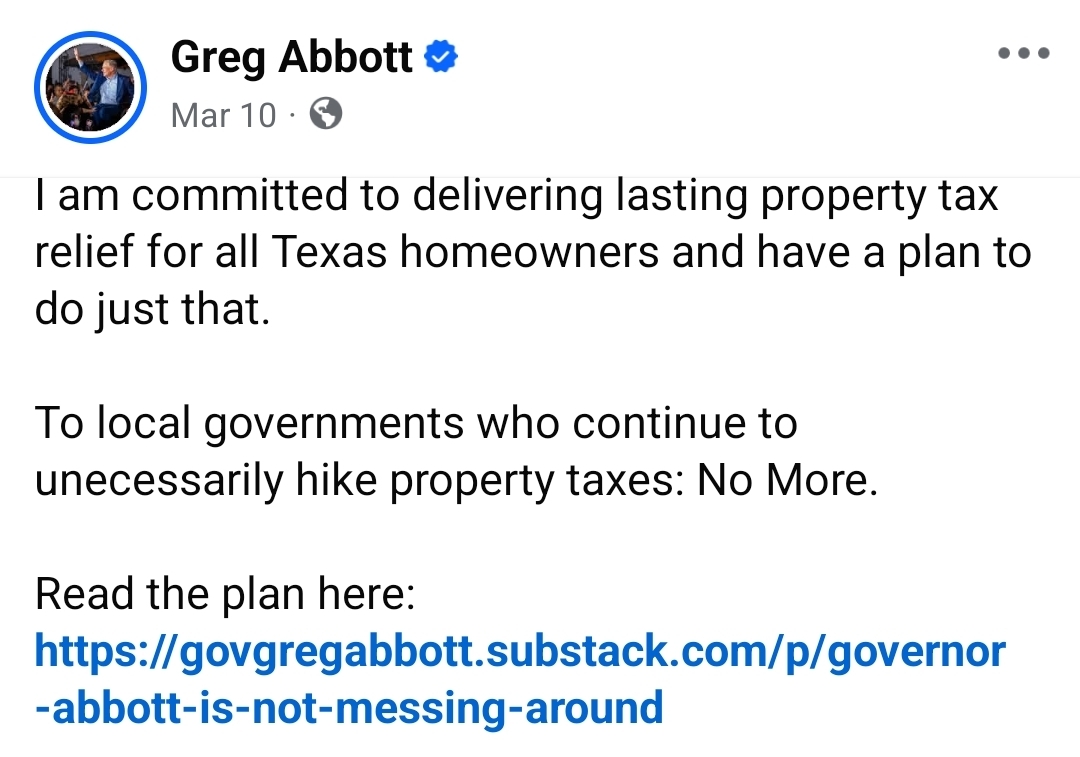
In the pointed social media message, the governor warned: “To local governments who continue to unnecessarily hike property taxes: No More.” That message, paired with a campaign-backed Substack outlining a five-point property tax plan, makes clear the governor is not only advancing policy but also applying political pressure to ensure it passes. This proposal would replace simple majority rule with a supermajority requirement, meaning a minority, just over one-third of voters, could block a tax increase even if a majority of the community supports it, which would limit appraisal growth, and, most notably, create pathways to eliminate school district property taxes altogether. While framed as tax relief, the plan would have sweeping consequences for local governmental functions such as police and fire and in particular public education, as well as the state’s finances.
At the center of this proposal is a fundamental shift away from locally generated and voter-approved funding, including school funding, toward a system that would rely far more heavily on the state and create a bigger state government while almost certainly diminishing public services. Local school district property taxes currently serve as a primary funding source for Texas public schools, and any effort to reduce or eliminate them raises a critical unanswered question: Where will the state find the money to replace billions in lost local school funding? The scale of this shift is significant. Texas public schools serve more than 5.5 million students, and total public education funding approaches $40 billion to $50 billion per year. Local property taxes account for more than half of that total. If those taxes were significantly reduced or eliminated, the state could be responsible for replacing an estimated $40 billion to $60 billion every two years that is currently supported by local revenue. This would represent one of the largest fiscal restructurings in Texas history.
Under the current system, Texas relies on a blended approach in which local property taxes fund a substantial portion of education costs and the state supplements that funding through general revenue, primarily sales tax. If local taxes are reduced, the legislators would need to balance the state budget with substantial cuts, a substantial hike to the sales tax, creation of a new revenue source, or potentially all three. Each of these options carries trade-offs:
- Increasing reliance on sales tax raises equity concerns as it would disproportionately affect lower-income Texans, and more Texans would likely shop out of state instead of locally.
- Creating a new revenue source is both political and logistically challenging.
- Cutting other parts of the budget would require difficult decisions that could have an impact on health care, infrastructure, or public safety.
Abbott would like Texans to believe we can simply cover the cost through economic growth. However, depending on economic growth to cover an additional $50 billion structural deficit on top of an already-existing $50 billion structural deficit is not sustainable—even in the short term.
In reality, eliminating school property taxes would likely require both a constitutional amendment and a complete redesign of the school finance system, making this far more than a simple policy adjustment. So is this simply a campaign promise, or is there the political will to actually redesign the system?
Texas has already seen a version of this shift through House Bill 3 in 2019, which compressed school district tax rates and increased the state’s share of education funding. HB 3 provided escalating property tax relief while also providing a one-time boost to per-student funding. Unfortunately, over time, state funding has not kept pace with inflation or enrollment growth, in part due to the escalating cost of property tax reduction. This caused districts to experience a decline in real purchasing power. Lawmakers have since faced ongoing pressure to increase funding to catch up. This experience highlights a key risk in the current proposal. One-time or short-term state investments are not the same as sustained, long-term funding commitments. If local property taxes are reduced on a much larger scale, the challenge of maintaining adequate and stable funding becomes even more pronounced.
The governor’s campaign is actively working to publicly align legislators behind this proposal through a “Texas Taxpayer Empowerment Pledge,” signaling support for the plan and suggesting potential political consequences for those who do not sign on. This reflects a broader trend of increasing political pressure on lawmakers to support sweeping policy changes related to education and taxation. The fact that many of the Republican lawmakers on the list are former school board members who understand the gravity of this policy shift suggests the proposal may be largely for show, not something that will actually happen—but only time will tell.
For educators, this debate is about far more than property tax bills. It is about whether school funding will remain stable and predictable, whether local communities will retain meaningful control over their schools, and whether the state is prepared to fully and sustainably fund public education if local revenue is reduced. As this proposal moves toward the legislative session, one question will define the conversation: If local funding is reduced, will the state truly replace it in a way that is reliable over time? Recent history suggests that without a long-term commitment, schools may ultimately be asked to do more with less. Again.
CONVERSATION
RECOMMENDED FOR YOU
08/21/2026
Teach the Vote’s Week in Review: Aug. 21, 2026
Public education continues to dominate conversations on the campaign trail, with candidates turning their attention to library books and “administrative bloat.” Plus: House Pensions Committee holds interim hearing on TRS.
08/21/2026
On the Campaign Trail: Aug. 21, 2026
Abbott and Hinojosa both spent much of their airtime this week on public education issues, including a call from the governor to audit school districts.
08/21/2026
Analysis: A tale of two audits
An audit finds “administrative bloat” at TEA—but the governor turns his attention to his perception of the same issue in school districts.